
Finding Leesylvania Residents by Record
Leesylvania is an unincorporated census-designated place, not a city with its own clerk or municipal assessor. Prince William County and Virginia agencies therefore hold the useful records. A property result can identify an owner of record; a court result can identify a party to a case; an old directory can place a household at an address in a particular year. None alone creates a complete roster of people at a home. The Leesylvania residents directory is a way to organize those source-specific answers, not a private-person database.
Use the strongest detail already in hand. An exact street address is best for the parcel map. A full name, middle initial, or former surname is better for court, probate, and historic-index work. For a person who may have moved, keep a dated list of every address, name spelling, and document number rather than joining matching surnames too quickly.
- Search the county property system by address, owner, or GPIN and record both the situs and mailing addresses.
- Use the map and deed index to connect the present parcel to its legal description and recorded parties.
- Check the appropriate voter, court, vital-index, or probate source for a dated second record.
- Move to RELIC, Library of Virginia microfilm, or the Clerk’s Historical Online Portal when the question is historical.
- Ask the custodian for an existing record or copy when the online index ends, stating the record series and date range.
Note: A renter, utility customer, protected voter, or household member may not appear in any of these public sources.
Leesylvania Residents at County Desks
Three public desks do most of the current-record work for Leesylvania. The assessor maintains a parcel and tax record. The Circuit Court Clerk indexes land, probate, marriage-license, and court material. Elections maintains the statutory registration list. Each gives a different kind of evidence, and the county offices are the right starting point because Leesylvania has no separate municipal records desk. The complete address-first sequence belongs on the By Street page.
Circuit Court Clerk
9311 Lee Avenue
Manassas, VA 20110
Land records, probate, and court records
Real Estate Assessments
Prince William County
Property and tax-record custodian
703-792-6780
Office of Elections
9250 Lee Ave., Suite 1
Manassas, VA 20110
703-792-6470
Leesylvania Property Roll Search
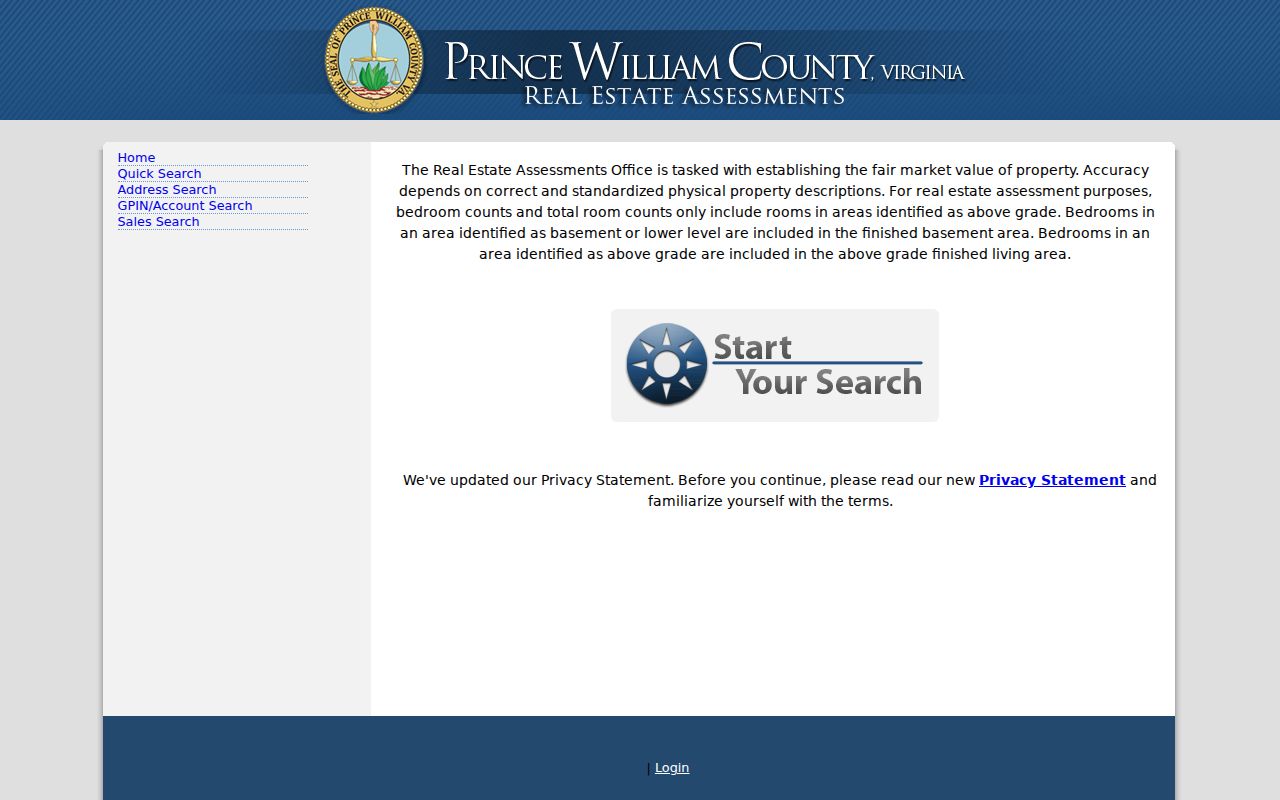
Public Access Now is the county’s main assessment entry point. Its landing page offers Quick Search, Address Search, GPIN/Account Search, and Sales Search. A returned assessment record may supply an owner, tax mailing address, situs address, legal description, sale date or price, building and land description, and assessed value. The page does not turn an assessment into proof that an owner currently occupies the parcel. For the Leesylvania residents directory, it is the property-owner layer rather than a list of every person at the address.
The assessment screen in the image below is the first useful stop for a contemporary name or address. It is especially helpful when a street number is known, because the official parcel identifier can then be carried into the map and deed records.
Prince William’s Public Access Now search presents the property-search routes used for a Leesylvania residents directory search.
Use a tax mailing address as correspondence evidence only. The situs address is the parcel’s physical location, and the two can differ for an estate, business, investor, or owner who lives elsewhere.
| Public Access Now route | Best use | What remains uncertain |
|---|---|---|
| Quick Search | Owner or general property lead | Exact rendered fields require a live session |
| Address Search | Situs or street-address trail | Owner is not every occupant |
| GPIN/Account Search | Known parcel or tax identifier | GPIN is not a household identifier |
| Sales Search | Recorded sale and assessment context | A sale does not establish current residency |
Leesylvania GPINs Keep Addresses Straight
Prince William County Mapper connects an address to its geography. It can query an address, GPIN, intersection, coordinate, map selection, or visible layer. Its GPIN format is xxxx-xx-xxxx, and partial GPIN searching is accepted. Parcel, premise-address, building, subdivision, and ZIP layers make it useful before interpreting an assessment card or a deed.
A GPIN is a coordinate-based ten-digit parcel identifier. It does not encode a subdivision or parcel size. A boundary adjustment can create a new GPIN, and a disjoined parcel may have more than one polygon. For that reason, preserve the deed’s legal description too. It is often the steadier bridge when an old road, street number, or postal label changes.
- Parcel
- A mapped piece of real estate used in county assessment and GIS systems.
- GPIN
- Prince William’s location-based parcel identifier, used to cross-check a mapped property.
- Situs address
- The physical property address used for the parcel, permits, and emergency addressing.
- Legal description
- The lot, block, subdivision, metes-and-bounds, or tract language in a recorded instrument.
Current Leesylvania Residents Records
There is no single current Leesylvania residents directory. The most useful public sources organize people by a legal role: owner, registered voter, recorded party, license holder, or business filing. The table separates what a source can actually support from the tempting but unsupported conclusion that everyone connected to an address lives there. Use a residents directory result as an invitation to check the custodian, not as a final identity decision.
| Source | Person or place clue | Custodian | Access path |
|---|---|---|---|
| Assessment/property record | Owner, mailing and situs address, sale, legal description | Real Estate Assessments | Public Access Now and office help |
| Registration list | Registered name, address, birth year, gender, districts | Office of Elections | Statutory inspection at registrar |
| Recorded land document | Grantor, grantee, recording detail, legal interest | Circuit Court Clerk | Index, image, counter, or copy request |
| Professional or entity file | License or public business affiliation | Virginia agency | DPOR or SCC official search |
| Community association listing | Association contact or mapped coverage | Neighborhood Services | Voluntary contact list, not membership roll |
For a single person, compare at least two independent facts such as an address, middle initial, role, document date, or legal description. A common surname, a business address, and an undated mailing address are weak identity matches.
Leesylvania Precinct 712 Records
Leesylvania appears in county election mapping as Precinct 712. Virginia Code §24.2-444 defines what may appear in public registration lists: name, address, year of birth, gender, and applicable election districts. The list is inspectable at the registrar during business hours. It is not a live count of everyone at a property, and Virginia does not register voters by party.
The Virginia Citizen Portal is intended for a voter to check that voter’s own status, polling place, districts, absentee status, and voting history. Full date of birth, Social Security information, protected addresses, application data, and other excluded material do not become public simply because a registration list exists. Record the inspection date before treating a registration as a historical clue.
Leesylvania Names in Court and Vital Indexes
A court search and a vital-record index solve different name questions. The state case system routes a searcher to Prince William Circuit, General District, and Juvenile and Domestic Relations courts. Circuit instructions use locality, Criminal or Civil division, Name, Case Number, or Hearing Date. Online Prince William Circuit information begins July 1, 1989, while juvenile, adoption, and sealed cases are excluded. Courthouse computers may show more current scanned material than the status-focused web result.
Virginia vital certificates remain restricted even though the public index has minimum name, date, and county or city fields. Under Va. Code §32.1-271, birth records become public after 100 years; death, marriage, divorce, and annulment records after 25 years. The Virginia Department of Health’s current fee is $15 per copy or system search effective July 1, 2026. Eligible requests require the proper relationship and identification, and a vital index is not a substitute for a certified certificate.
Leesylvania Deeds and HOP History
The Clerk’s land-record trail starts with a present owner and legal description, then follows that owner as a grantee and the prior seller as an earlier grantee. Modern deeds and related land-record indexes/images are published from 1918 forward. Occasional users can search the index without charge, while image purchases cost $0.50 per image plus a $2 internet convenience fee. Counter copies are $0.50 per page and certification adds $2. That price and access distinction matters when a residents directory search needs a record image rather than an index hit.
The historical trail requires patience. Prince William formed in 1730, and many pre-Civil-War books were lost, destroyed, or stolen during the 1863 wartime disruption. The returned Liber A, the first deed book, is a rare recovery. The Clerk’s Historical Online Portal offers historic deeds, wills, and lists of heirs, but HOP does not repair every missing volume. RELIC, Library of Virginia microfilm, tax and rent lists, court minutes, probate, and adjoining-owner descriptions become important when a deed cannot be found.
| Access route | Index or image | Practical tradeoff |
|---|---|---|
| Occasional Eagle Recorder use | Free inquiry; paid images | Good modern starting point for a known party |
| Clerk counter or request | Copies and certification available | Best when a formal copy or procedure help is needed |
| HOP and Historical Document Room | Selected historic deeds, wills, and heirs | Coverage changes by record group |
| RELIC and Library of Virginia | Surviving microfilm and compiled indexes | Essential where online access or original books end |
RELIC’s Leesylvania Research Shelf
RELIC, the Ruth E. Lloyd Information Center at Central Library, is the county’s strongest local-history stop. It holds family files, microfilm, maps, photographs, yearbooks, church and cemetery material, local newspapers, and digital collections. Its local news index covers Prince William papers systematically from 1993, with some obituaries reaching back to 1970. Staff can help identify a reel, finding aid, or catalog route, though old and current specialist hours differ, so call before visiting.
Its Digital Archives include a Prince William deed index for 1731–1827, People 1701–1865 material, rent rolls and tax lists, probate indexes, vital-record compilations, churches, and historic maps. Those are locating tools rather than universal proof. For family reconnection or an heir question, pair an index hit with the underlying image, a will or list of heirs, an obituary, and a dated property record.
RELIC also provides a useful fallback when a search label is newer than the source. Older material may be cataloged under Prince William County, Dumfries, Brentsville, Woodbridge, Neabsco, or a road and waterway name instead of Leesylvania. Try those historic place names with a surname, then record the reel, collection, and page before comparing it with a current parcel.
Historic Leesylvania Resident Directories
Older directory research belongs to the county and state library shelves, not to a proven standalone Leesylvania series. RELIC and the Library of Virginia document city-directory microfilm and microfiche, and general Virginia holdings for major cities commonly range from the late nineteenth century to about 1940. The official sources do not publish an exact Leesylvania title, publisher, or year run, so the volume must be confirmed in a catalog or at the shelf.
When a reverse or criss-cross volume exists, it can lead from a street number to an occupant or household. An alphabetical entry may add a spouse notation, occupation, employer, address, or abbreviation. Pair its year with a census release year, then test the name against deeds, obituaries, and probate. The collection details and careful reading method are developed in the City Directories resource.
Leesylvania Property Alert Timing
Prince William’s free Property Alert System launched April 23, 2025. A custom alert can monitor a name or GPIN and send an email when a recording matches the selected term. It is useful for a property owner watching new recordings, not for proving occupancy or performing a full title search. The separate Find a Document route initially reaches only the prior three months, so an older question still needs the regular land-record index or Clerk assistance.
Save the search date and the exact GPIN or spelling used. An alert is a notice that a record matched the selected keyword. The deed image, legal description, document number, and party role still need to be reviewed before drawing a conclusion about a Leesylvania property.
Virginia FOIA for Leesylvania Records
When a county or state public body holds an existing record outside a routine portal, the Virginia Freedom of Information Act provides the general request path. A request should identify existing records with reasonable specificity. It does not require an agency to answer an open-ended question, create a record, or perform a search that the record does not support. A request for a defined report, document range, or stored index is more likely to help than a request to compile a Leesylvania residents directory from scattered records.
Under Va. Code §§2.2-3704 and 2.2-3704.01, a public body generally responds within five working days by providing, withholding under an exemption, partially disclosing, saying no record exists, or seeking clarification. Charges are limited to actual access, search, duplication, and supply costs. Ask for an estimate before authorizing a large request. Court-record access and voter material have their own rules, so name the record series and ask the correct custodian first.
Note: A precise request for a dated record series usually reaches the right office faster than a request to identify a private household.