
Leesylvania Previous Residents by Era
The best source for prior residents changes with the era. County Mapper and the assessment card establish the present parcel. The recorded deed chain provides legal ownership, while directory and census records can add a household layer. RELIC, the Clerk’s Historical Online Portal, and Library of Virginia microfilm keep the search moving when a date lies outside the modern land-record system. Exact local directory year runs and publishers were not identified on the public catalog pages, so record the volume and page only after a catalog or in-person check.
| Source | Years it covers | Where held | What it shows |
|---|---|---|---|
| County Mapper and assessment | Current system and annual/current assessment history | Prince William GIS and Real Estate Assessments | GPIN, situs, owner, mailing address, sales, and legal description |
| Modern deed and land index | 1918 to present | Circuit Clerk Eagle Recorder or courthouse | Grantor, grantee, dates, instrument or book/page, and land description |
| HOP deeds, wills, and heirs | Historic material into early modern periods; record group varies | Circuit Clerk Historical Online Portal | Historic finding aids and digitized material where available |
| RELIC and LVA land records | Surviving county books and microfilm through 1918 | Central Library RELIC and Library of Virginia | Deeds, plats, indexes, tax and rent evidence, and related local material |
| Directories and census | Directory run unverified; federal census through 1950 released | RELIC, LVA, NARA, and library databases | Address or household clues that need comparison with the parcel trail |
For a recent transfer, begin with the assessment owner and current deed. For a much older Leesylvania address, start with the legal description, then check HOP, microfilm, compiled indexes, tax lists, wills, and local history resources together. Note: an online coverage date marks a portal’s reach, not the beginning or end of the property’s history.
Fix a Leesylvania Address Before Going Back
Before tracing previous residents, enter the current address in Prince William County Mapper and record the returned premise address, GPIN, parcel geometry, ZIP, subdivision, and visible building information. Then open Public Access Now for the owner of record, tax mailing address, situs address, sale history, and legal description. The mailing address may be outside Leesylvania, so it should never replace the situs address in a house history timeline.
Keep the legal description beside the GPIN. The modern address is useful for opening current county systems; the legal description is the tract, lot, block, or metes-and-bounds language that tests a historical deed. Development Services ePortal also allows a public search by address, permit number, or project name without an account. A permit can add a date for a project, but the applicant or contractor is not automatically the owner or person who lived at the address.
Leesylvania Previous Residents in the Deed Chain
Ownership is only one part of a past-residents search, but it is the stable spine. Search the current owner in the Circuit Clerk index as a grantee, which means the party receiving the property in the purchase deed. Confirm the deed’s legal description against the assessment card. The seller on that deed becomes the next name to research as an earlier grantee. Each step needs the same-trace test, because a similar street name, a trust, an estate, or a subdivision phase can produce an incorrect result.
- Copy the current owner, GPIN, parcel address, and legal description from assessment and map records.
- Search that owner as grantee in the Circuit Clerk land-record index. Capture the grantor, recording date, instrument number or book and page, consideration when shown, and legal description.
- Compare the deed language with the parcel card and any cited plat. A plat can connect a street number to a lot and block.
- Search the seller, or grantor, as a prior grantee. Repeat the comparison rather than assuming each name result is the same tract.
- Flag deeds of trust, releases, estate transfers, foreclosures, boundary adjustments, and subdivision plats. They can explain a gap or branch in the usual sale-to-sale pattern.
- Grantor and grantee
- The grantor transfers an interest; the grantee receives it. Their roles, not just their names, drive the backward search.
- Chain of title
- A sequence of recorded transfers tested against the same legal tract. It is not a list of every household that used the address.
- Legal description
- The deed language that identifies land by lot, block, tract, survey, or boundaries and can remain useful after a street name changes.
Leesylvania Deed Access and Image Costs
The Circuit Clerk’s published online coverage for modern deeds and related land records begins in 1918. Occasional users can make index inquiries without charge. Images cost $0.50 each plus a $2 internet convenience fee, while a counter copy is 50 cents per page and certification adds $2. The annual Eagle Recorder subscription is $240. That difference matters when assembling a short, documented chain: the index can identify the instrument first, then a copy request, counter visit, or image purchase can be limited to the record that needs inspection.
The Eagle Recorder access agreement is the entry point for the Prince William land-record inquiry route used in a Leesylvania previous residents search.
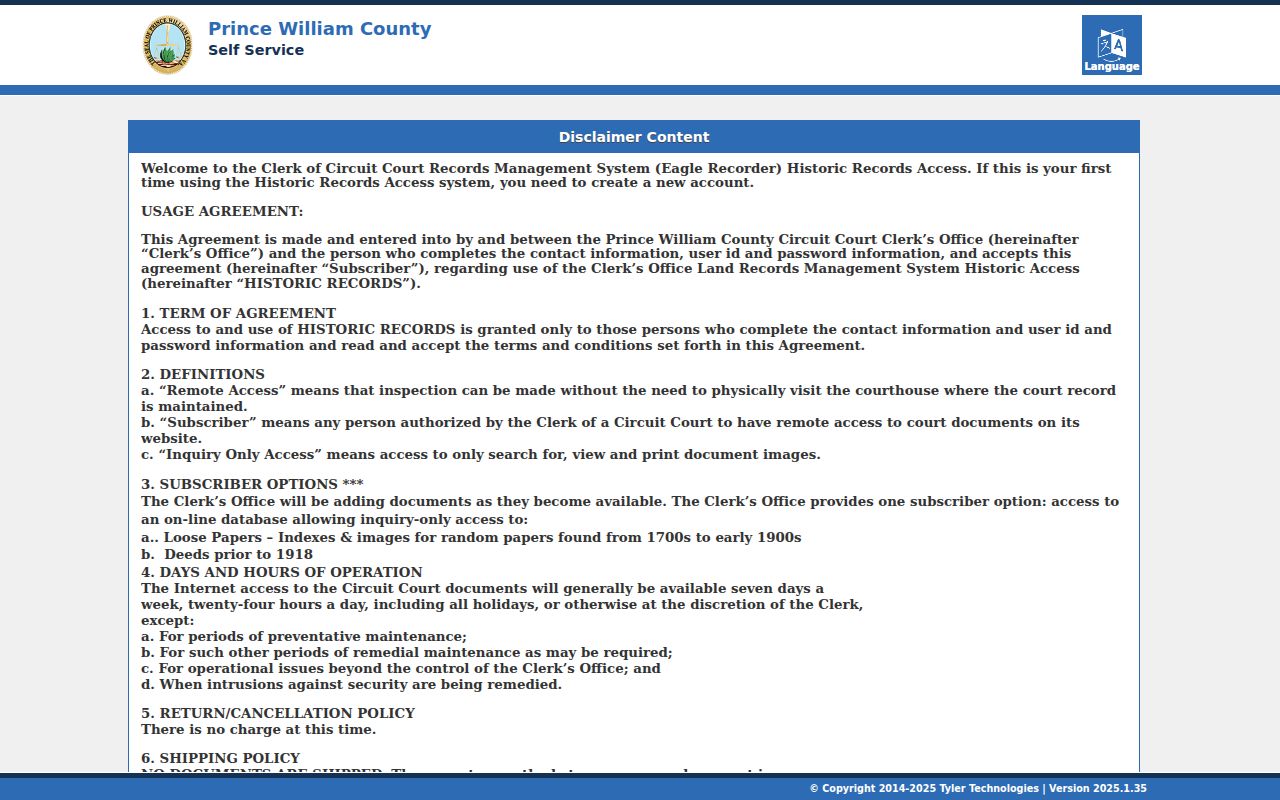
Use the index as a finding aid and inspect the image or official copy before relying on party role, tract language, or an apparent transfer date. The Clerk’s staff can explain procedure but does not perform a title search for a patron.
For a request that cannot be completed online, the Circuit Clerk is at 9311 Lee Avenue in Manassas. The research room, historic portal, copy-request process, RELIC, and Library of Virginia are complementary access channels, especially where an index finds a book and page but no image is available online.
Lost Leesylvania Books and Liber A
Prince William County was formed in 1730 or 1731, and Leesylvania records follow the county’s books rather than a local municipal archive. The Civil War created a major break in that trail. County histories report that records were looted or destroyed in 1863, including sixteen deed books and five will books. A missing pre-1865 deed is therefore not proof that the tract had no history or that a family never held it.
The returned Liber A is an important exception. The first deed book began in 1731, was taken during the war, and later returned to the county. HOP now includes historic deeds, wills, and lists of heirs, with selected material reaching into the 1700s and early 1900s. The 1731–1827 deed index is incomplete, so a past-residents trail can require tax lists, rent rolls, court minutes, wills, probate files, newspapers, and adjoining-owner descriptions alongside surviving deeds.
RELIC Sources for Leesylvania Previous Residents
RELIC, the Ruth E. Lloyd Information Center at Central Library, is the county’s local-history route for material that a modern parcel search cannot show. Its resources include county government microfilm, family files, maps, newspapers, cemetery and church material, yearbooks, photographs, indexes, digital archives, and research guides. It also preserves or points to surviving county records and local clues that can bridge the lost-book period. Current RELIC contact information lists 8601 Mathis Avenue in Manassas and 703-792-8380; call before a visit because older and current specialist-hour references differ.
The RELIC Digital Archives can be checked before travel for historic deeds, probate, churches, maps, and people indexes. The Library of Virginia’s Prince William microfilm catalog is the next archival channel when a needed reel or parent-Stafford record is not at the local library. Preserve a full citation for each find, including the reel, volume, page, date, and spelling used in the record.
Pair Leesylvania Directories With Census
Deeds identify an ownership trail, not every household. For the people who lived at a Leesylvania address in a particular period, use a reverse or criss-cross directory if one is available, then compare it with alphabetic entries, census schedules, obituaries, and probate. Public collection pages confirm that RELIC and the Library of Virginia hold city-directory microfilm or microfiche, but they do not publish a complete Leesylvania or Woodbridge title, publisher, and year run. Treat the catalog search as a necessary step, not a gap to fill by guessing.
- Search the directory catalog using Leesylvania, Woodbridge, Dumfries, Prince William County, the road name, and the surname. Record the actual title and year before relying on an entry.
- Check an address-organized section for the number and former street spelling, then compare an alphabetic entry for spouse, occupation, telephone, or household notation.
- Pair that year with the closest released federal census. The census is released on a 72-year schedule; 1950 has been public since 2022, while later schedules await their release dates.
- Use obituary, cemetery, will, and list-of-heirs material to test family relationships or an estate transfer. A death notice can be a lead, not final proof of residence.
The Leesylvania city directory collections explain the directory shelf and its limits. RELIC also has local newspaper indexes, Baker Funeral Home material, church and cemetery resources, and family-history collections that can help date a household without rewriting the legal parcel trail.
Former Leesylvania Street Names Matter
Prince William’s address system changes names and numbers as part of a countywide grid. An old directory or newspaper may use a road name that does not match the current assessment card. Search the old and current forms, then keep the GPIN and legal description as the bridge. That preserves the record trail when the front-facing address changes but the underlying tract continues.
The Route 1 change illustrates the problem. Jefferson Davis Highway became Richmond Highway on July 1, 2022, but the name change did not require a new deed. A historical address search should use both road names, the county’s address-change notices, the parcel identifier, and the legal description. Do not discard an otherwise sound record simply because its road label predates the current one.
Leesylvania Property Alerts and New Records
Prince William Circuit Clerk’s free Property Alert System launched on April 23, 2025. A user can create a custom recording alert using a name or GPIN and receive email notice when a matching document is recorded. It is useful for monitoring new documents affecting an identified parcel, but it does not establish occupancy, complete a title search, or repair an old gap in the deed chain.
Prince William Property Alerts shows the custom name or GPIN monitoring route available for a Leesylvania address.
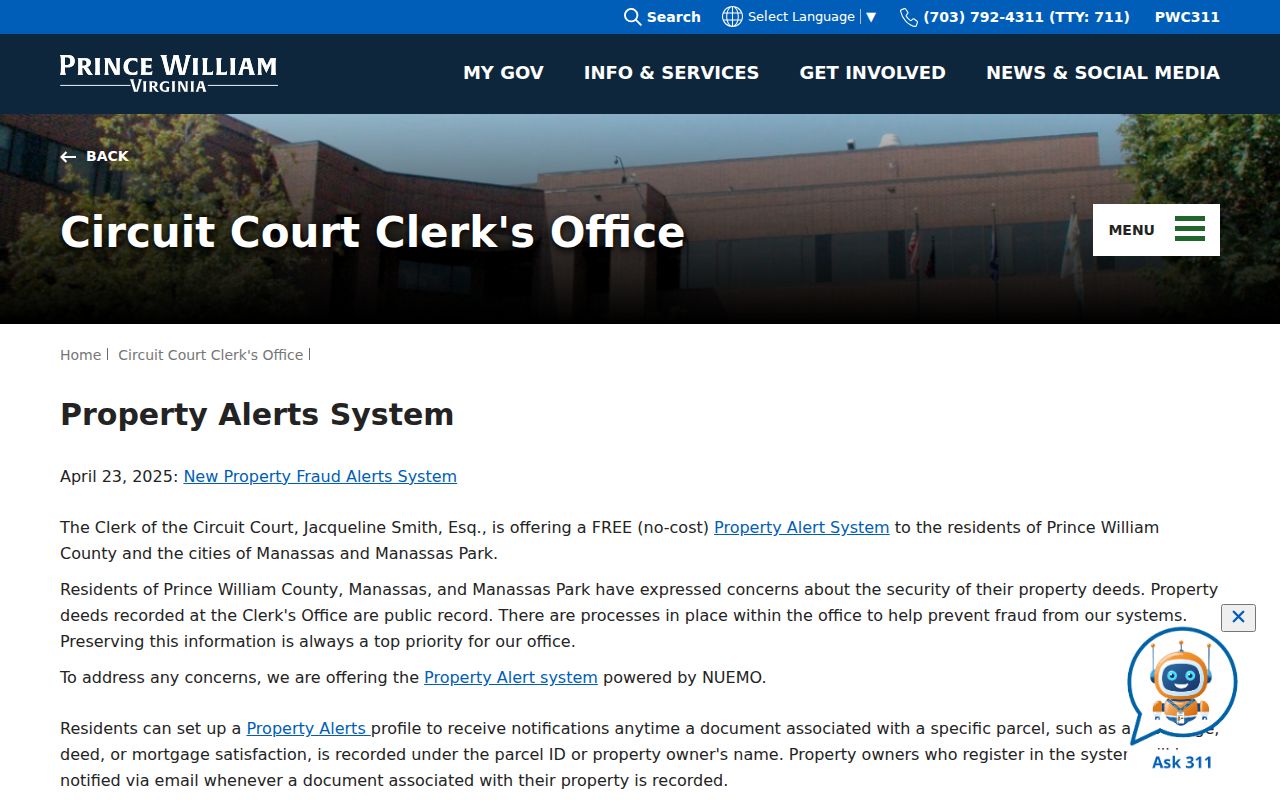
The system’s Find a Document option initially looks back only three months. Use an alert for future recordings and the Clerk index, HOP, counter, or archive channels for earlier periods.
Limits on Leesylvania Past Residents Trails
Past residents research must state what each source proves. An assessment card records an owner and county correspondence address. A deed records a legal transfer. A directory or census entry can place a household in a particular historical source. Probate and obituary records can suggest family relationships. None alone proves a complete history for an address, and protected addresses, sealed files, private utility data, and DMV records are not substitutes for missing evidence.
For a record that is not online, contact the custodian for a copy request, inspection route, or archival referral. Virginia FOIA applies to existing public records and does not require an agency to create a new record or resolve a private identity question. A clear timeline that records the source, date, name form, legal description, and remaining uncertainty is more useful than a confident but unsupported list of past residents.